Water contamination is a common but often hidden cause of industrial equipment failure. It can enter lubricating oil through cooler leakage, humid air, steam condensation, tank breathing, poor sealing or maintenance work.
At first, the oil may only look slightly cloudy and the machine may continue running. But inside the system, water is already weakening lubrication, accelerating oil degradation and damaging metal surfaces. For turbines, compressors, gearboxes, hydraulic power units and rolling mills, water in oil is not just an oil quality problem. It is an equipment reliability risk.
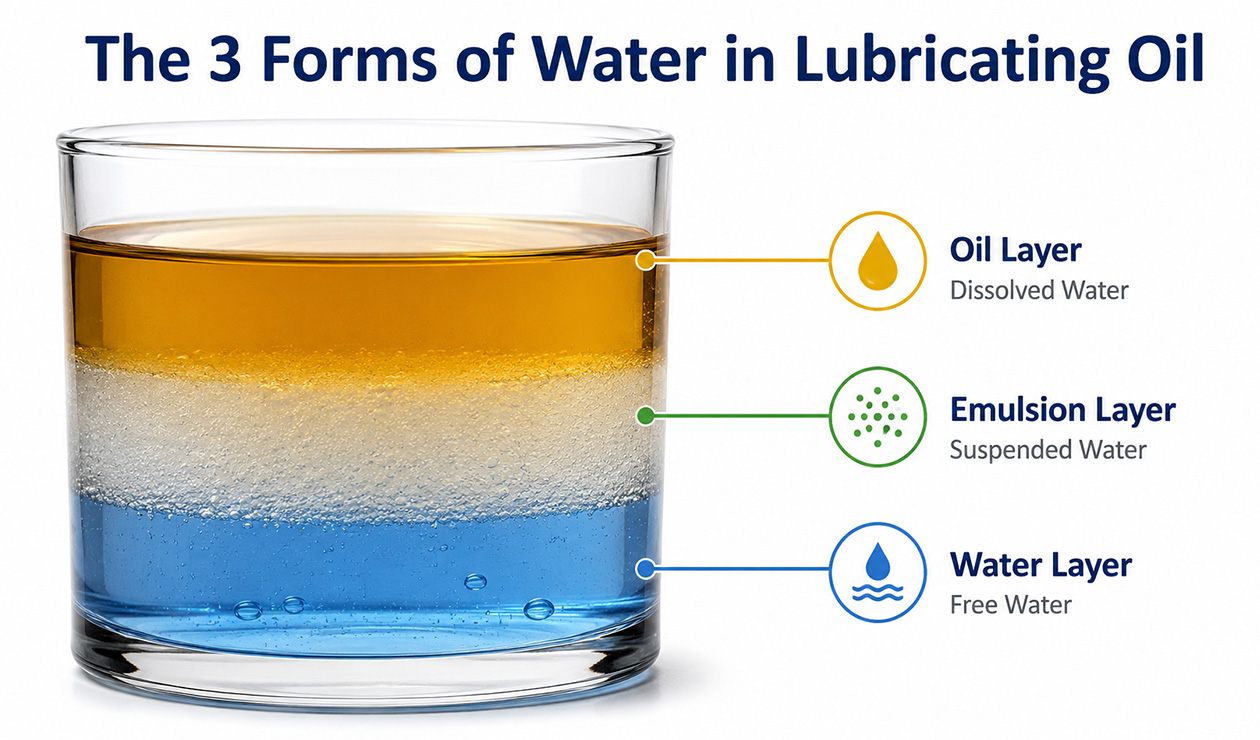
Water can exist as dissolved water, emulsified water or free water. Dissolved water is usually invisible. Emulsified water appears as tiny droplets suspended in the oil and often makes the oil cloudy. Free water separates from the oil and settles at the bottom of tanks or low-flow areas.
Water may exist in oil in three main forms:
| Form of Water | Description | Equipment Risk |
| Dissolved water | Water is dissolved in the oil and is usually invisible | Promotes oxidation and chemical degradation |
| Emulsified water | Tiny water droplets are suspended in the oil | Reduces lubrication performance and accelerates sludge formation |
| Free water | Water separates from the oil and settles in the tank or low points | Causes corrosion, rust, pitting and severe component damage |
Industrial equipment depends on a stable oil film to separate moving metal surfaces. Bearings, gears, pumps and hydraulic components all need this film to carry load and prevent direct contact.
When water enters the oil, the oil film becomes weaker. Under high load, high speed or high temperature, the system may shift from full-film lubrication to boundary lubrication. This increases friction, heat and wear. Common signs include rising oil temperature, abnormal noise, vibration, gear wear and bearing damage.
Bearings are highly sensitive to water-contaminated oil. Water reduces lubrication strength and allows small areas of metal-to-metal contact. Over time, this can lead to micro-cracks, pitting and surface fatigue.
Water can also promote corrosion fatigue. Once rust or pitting begins on a bearing surface, repeated rolling contact can enlarge the damage and eventually cause spalling or bearing failure. For critical equipment, this often means unplanned shutdown and high repair cost.
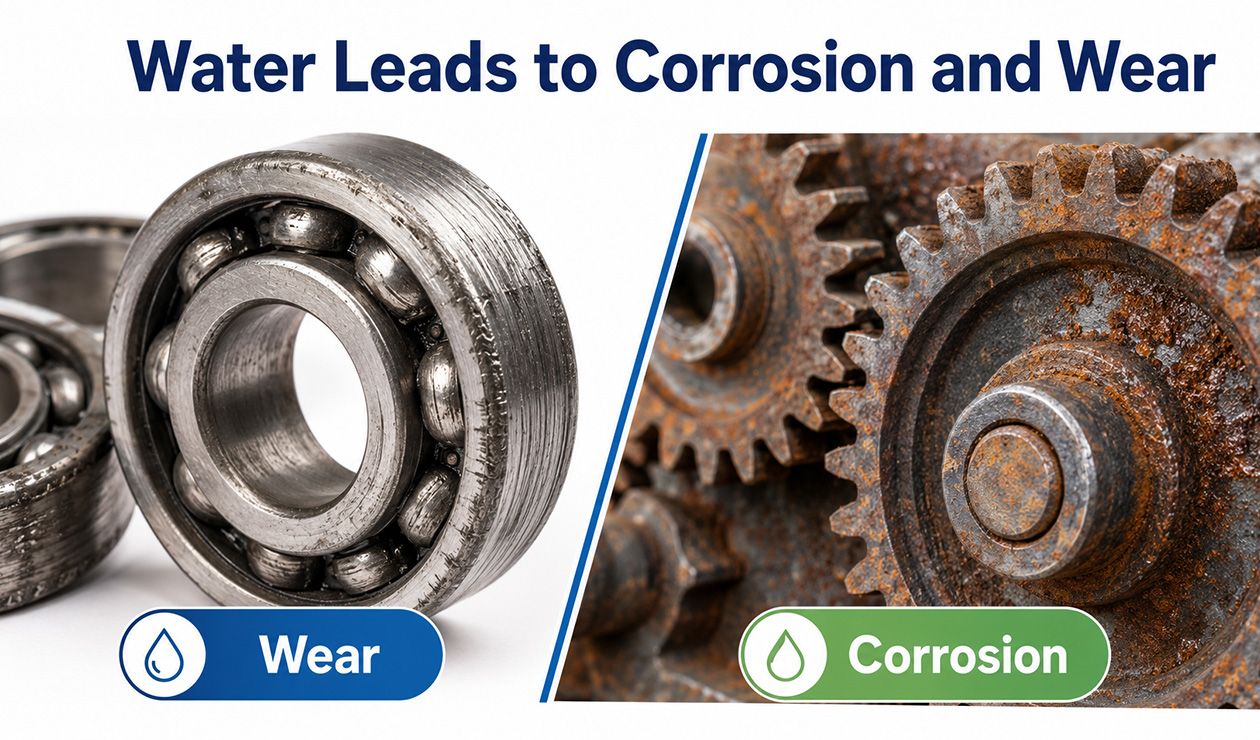
When water, oxygen and metal surfaces exist together, corrosion becomes much easier. Rust can form on bearings, gears, oil tanks, pipes, coolers and valve surfaces.
Corrosion damages metal surfaces and generates hard rust particles that circulate through the oil and create abrasive wear. This is especially risky in hydraulic systems, turbine control systems and servo systems, where small clearances require clean oil.
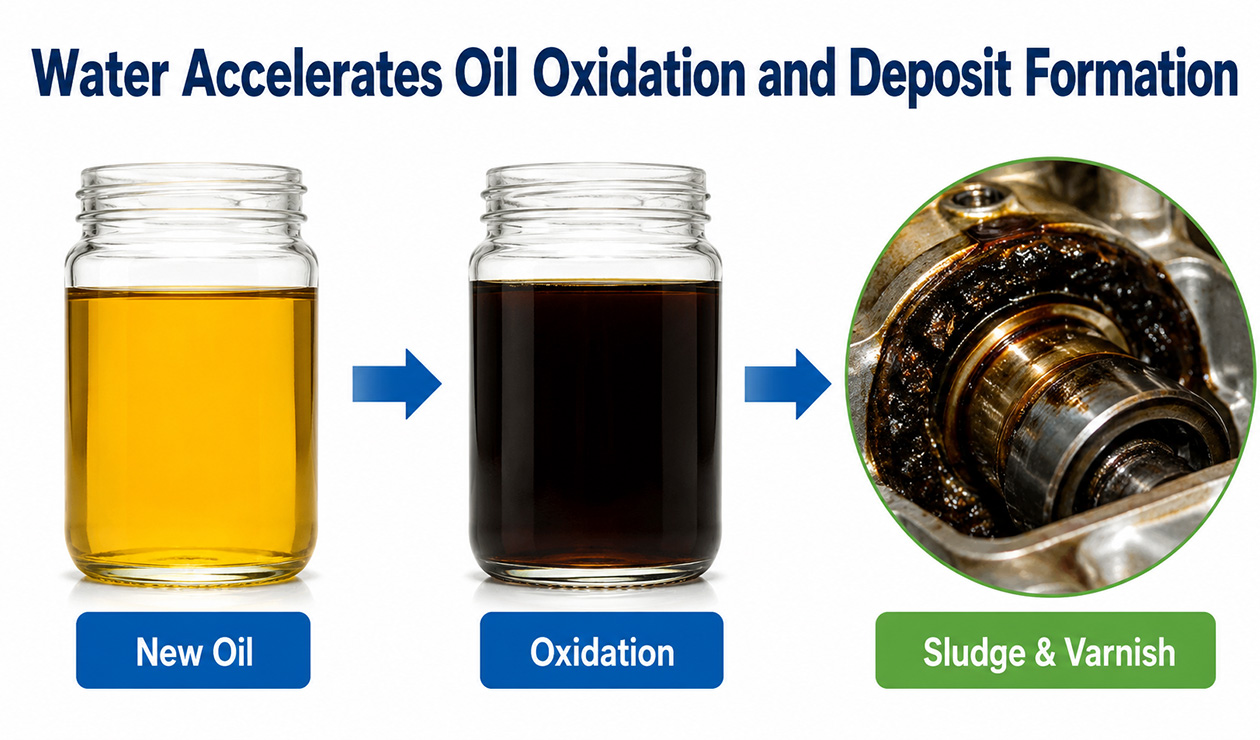
Water accelerates oil oxidation. As oxidation increases, oil color may darken, acid number may rise and viscosity may change. Oxidation products can form sludge and varnish.
These deposits may attach to bearings, servo valves, control valves, heat exchangers and oil passages. In hydraulic and turbine control systems, varnish can cause valve sticking, slow response and unstable control. On heat exchangers, deposits reduce cooling efficiency and push oil temperature even higher.
Modern lubricating oil depends on additives such as antioxidants, anti-wear agents, rust inhibitors, demulsifiers and anti-foam agents. Water can reduce or destroy these functions.
Some additives may hydrolyze in the presence of water. Rust inhibitors may be consumed faster. Anti-wear protection may decline. Once the additive system is damaged, simply removing water may not fully restore the oil’s original performance.
Changing oil may seem simple, but it does not always solve the problem. Large systems may contain hundreds or thousands of liters of oil. More importantly, water, sludge and deposits may remain inside tanks, pipes, coolers and dead zones. New oil can be contaminated again if the root cause is not corrected.
A better approach is to combine root-cause inspection, oil analysis, filtration and dehydration.
Preventing failure requires regular oil analysis to monitor water, particle cleanliness, and wear metals. Once contamination is detected, a dual-action system is needed:
Precision Filtration: Precision Oil Purifier captures the microscopic rust particles and sludge generated by water.
Vacuum Dehydration: To remove emulsified and dissolved water, our TRVS Vacuum Dehydration systems lower the boiling point under a vacuum, safely extracting deep moisture at low temperatures without damaging vital additives.
Operating as an online bypass filtration loop, these systems continuously clean and dry your lubricant without disrupting main equipment operations.
Water in lubricating oil is a silent threat to industrial equipment. It weakens oil film strength, increases wear, causes corrosion, accelerates oxidation, forms sludge and varnish, damages additives and may finally lead to unplanned downtime.
Clean and dry oil is not only better lubricant. It is the foundation of safer, more stable and more reliable industrial operation.
PREV: No content
NEXT: Phosphate Ester Fire-Resistant Oil How Acid Number and Resistivity Indicate Oil Condition

AITAI, founded in 2013, is a high-tech enterprise focused on TEL. As the strategic partner of 3R Group Japan, we provides ultra-precision purifiers, on-site solutions, and oil testing& analysis, Serving metallurgy, automobile, power, marine, petrochemical, and machinery industries.


Email:chunlianyang@aitaitech.com
Address: Room 1105, Building B, Aotekexing Science Park, Yuehai Street, Nanshan District, Shenzhen
|
|
 Lubrication Management Expert