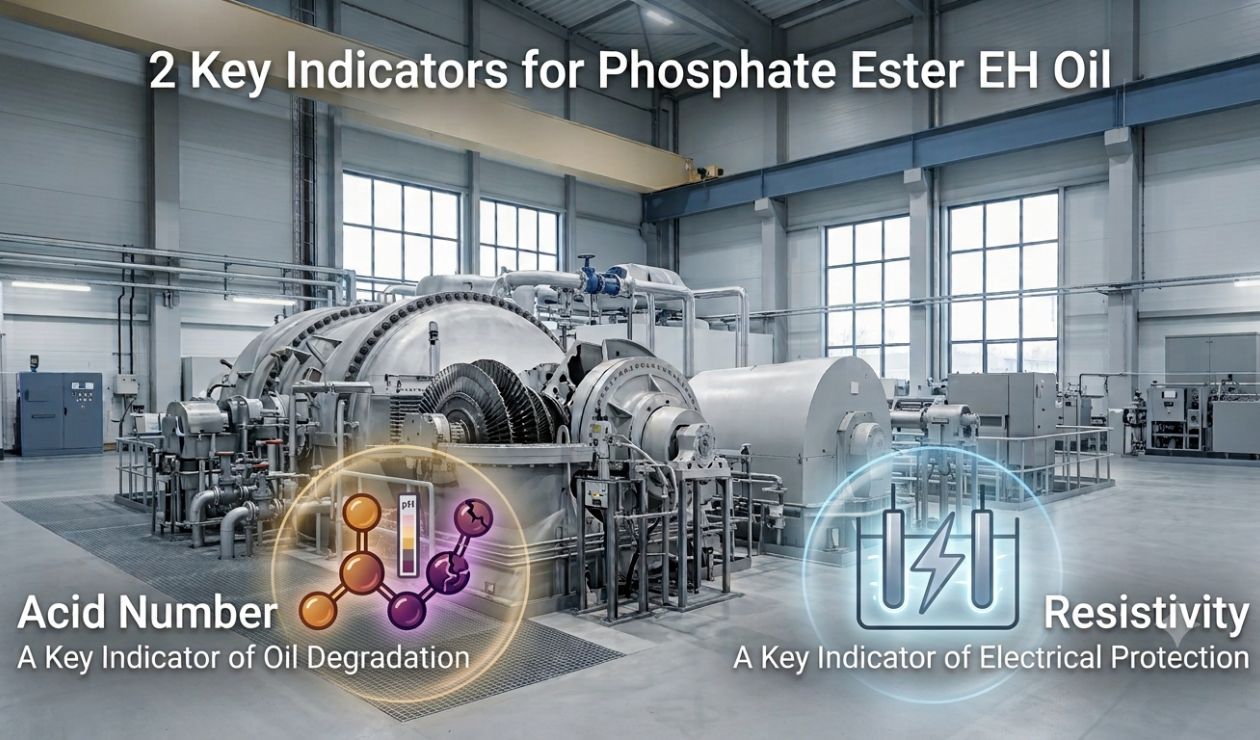
Phosphate ester fire-resistant oil, commonly known as EH oil, is widely used in steam turbine electro-hydraulic (EH) control systems and high-temperature, high-pressure hydraulic applications.
During service, water, heat, oxidation and contamination can gradually change the condition of EH oil. Two important indicators for monitoring these changes are Acid Number and Resistivity.
Together, they provide useful information for assessing oil degradation, electrical properties and the risk to sensitive EH components such as servo valves.
Acid Number measures the level of acidic substances in the oil and is expressed in mgKOH/g.
As phosphate ester oil deteriorates, its Acid Number generally increases. Excessive acidity can accelerate hydrolysis, promote sludge and deposit formation, reduce Resistivity, and increase the risk of corrosion and servo valve problems.
Recommended control values:
A rising Acid Number should prompt investigation of possible causes such as water contamination, oxidation, high operating temperature, metal contaminants and incompatible sealing materials.
Resistivity indicates the oil's electrical properties and is expressed in Ω·cm. Higher Resistivity generally indicates better electrical insulation performance and a lower risk of electrochemical corrosion.
A decrease in Resistivity may indicate water or metal contamination, acidic or polar degradation products, or contamination entering through inadequate sealing. In an EH system, this can increase the risk of corrosion and malfunction in precision components such as servo valves.
Recommended control values:
Acid Number and Resistivity should be evaluated together with other oil condition data rather than used as isolated indicators.
Oil testing is most useful when test results lead to a clear maintenance decision.
|
Test Result |
What to Check |
Action |
|
Acid Number increases |
Water, oxidation, temperature, degradation |
Investigate the cause; Consider regeneration or oil replacement |
|
Resistivity decreases |
Water, metal particles, degradation products, sealing |
Check contamination sources and oil condition; Purify or regenerate as appropriate |
|
Both change significantly |
Overall oil degradation and contamination |
Perform a broader oil condition assessment before deciding on treatment or replacement |
For moderately deteriorated phosphate ester oil, filtration, purification or regeneration may help remove contaminants and degradation products and extend oil service life.
If the oil is severely degraded, oil replacement may be necessary.
Treatment should always be followed by retesting to verify whether the oil condition has improved.
A practical condition-based maintenance programme should include:
Test new oil before use. For in-service EH oil, testing every 3–6 months is recommended. For critical systems, the interval can be shortened to 1–3 months based on operating conditions and oil condition.
Prevent water, dust and solid contaminants from entering the system. Maintain proper sealing and keep filtration equipment in good condition.
When test results show deterioration, identify the cause first, then select filtration, purification, regeneration or oil replacement according to the actual oil condition.
For phosphate ester fire-resistant oil requiring regeneration and purification, AITAI ZJ Series is designed for this application and can be incorporated into an oil maintenance programme.
Monitoring Acid Number and Resistivity provides an early indication of changes in phosphate ester EH oil. Combined with contamination control and condition-based treatment, this approach can help protect servo valves and other precision components while reducing unnecessary oil replacement and unplanned downtime.

AITAI, founded in 2013, is a high-tech enterprise focused on TEL. As the strategic partner of 3R Group Japan, we provides ultra-precision purifiers, on-site solutions, and oil testing& analysis, Serving metallurgy, automobile, power, marine, petrochemical, and machinery industries.


Email:chunlianyang@aitaitech.com
Address: Room 1105, Building B, Aotekexing Science Park, Yuehai Street, Nanshan District, Shenzhen
|
|
 Lubrication Management Expert